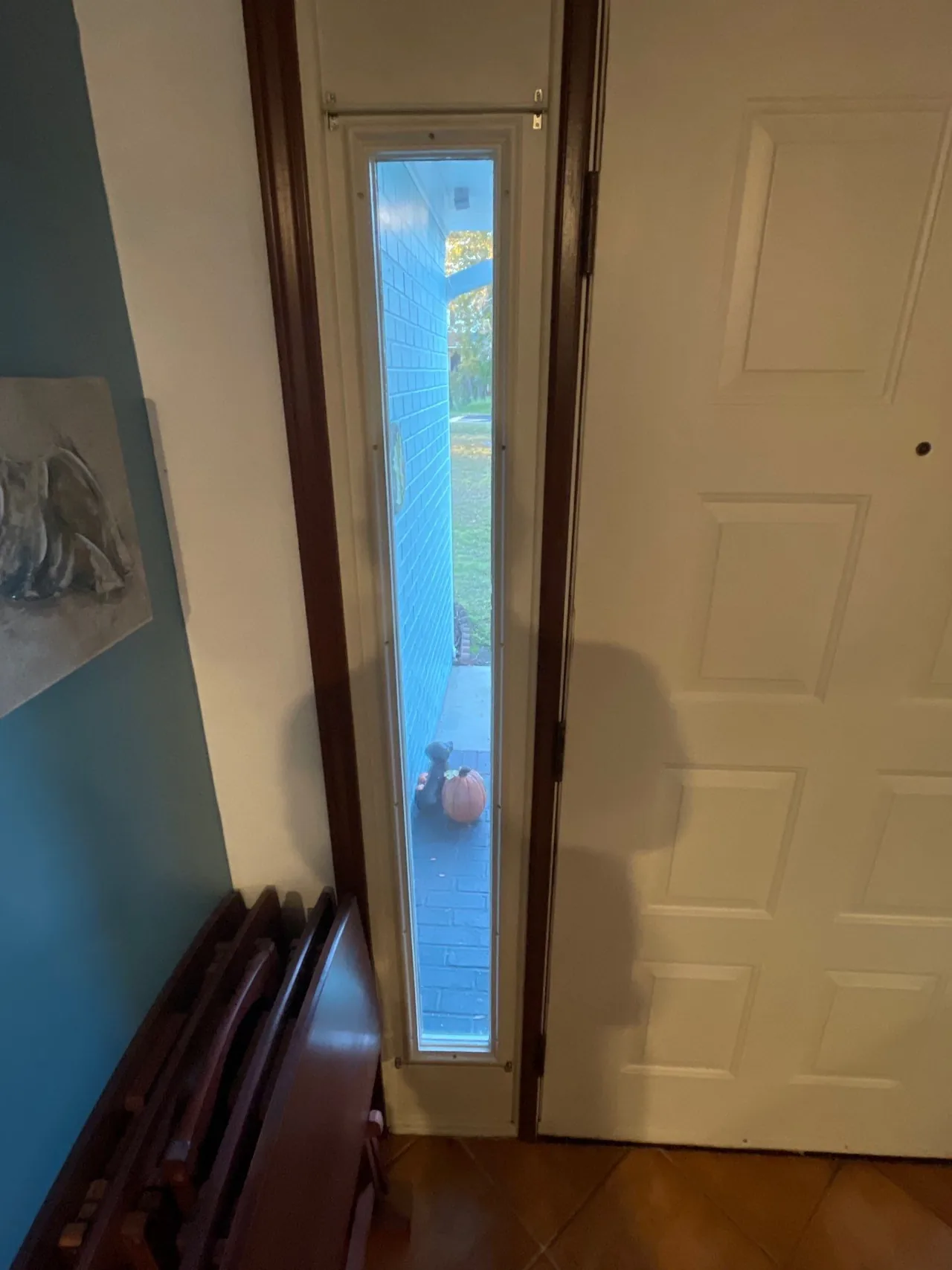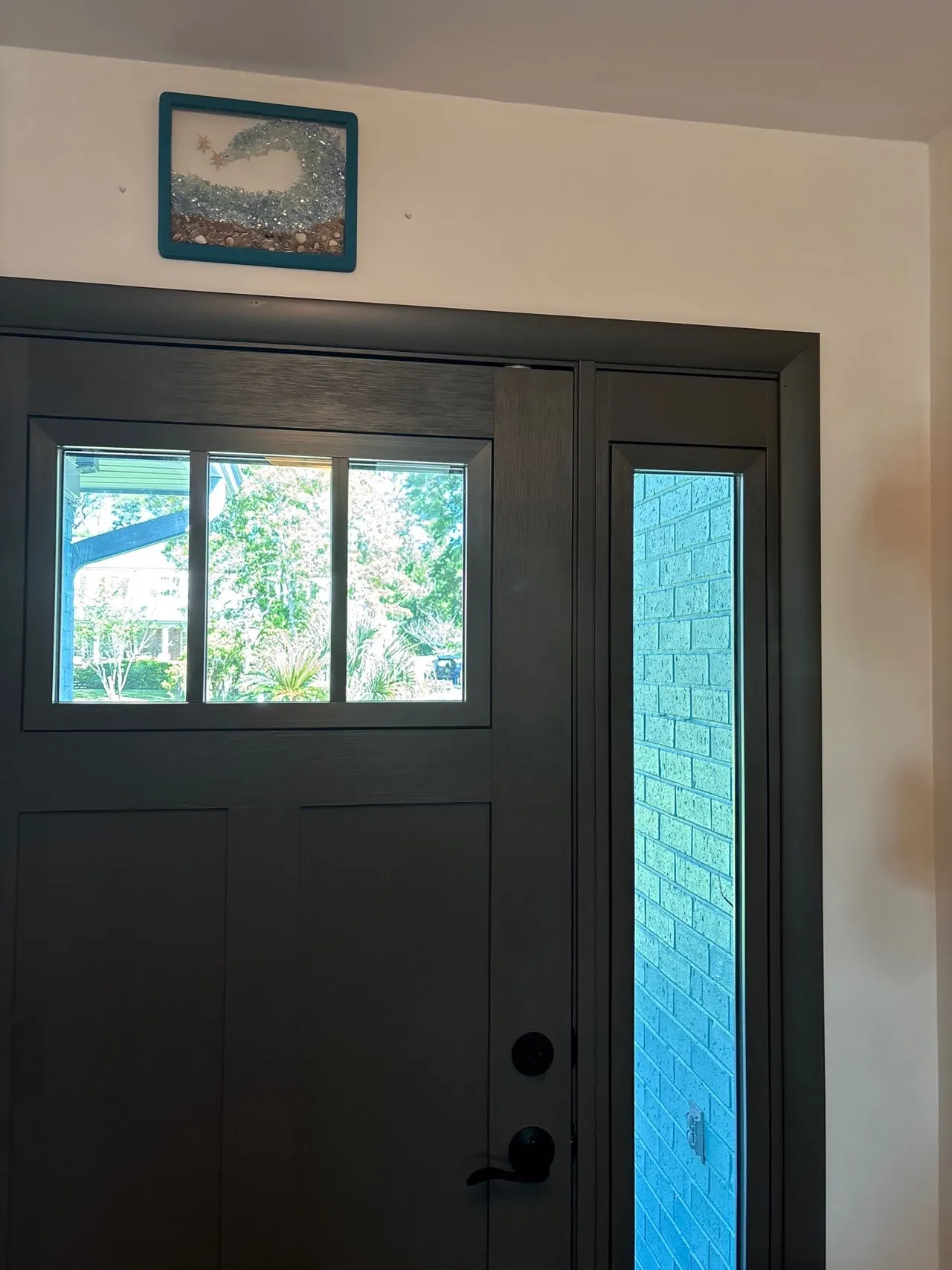
Decide what you want to see with the door closed
Project at a glance
- Local example
- Myrtle Beach, South Carolina
- Recorded work
- Two-panel OKNA Elegante sliding patio-door replacement
- Photographs
- Original room-side curtain and finished gridded slider
- Order comparison
- Factory-blind option separately documented by OKNA
Start with the slider closed, because that’s when both options have the same job. Stand where you usually come into the room or sit down. Do you want to keep the view while cutting sight lines from one direction? Or would you rather pull fabric across the whole opening at the end of the day? Those are different ways to use the same door. Write down what you want to see at the time you’re most likely to reach for the privacy control.
An OKNA mini-blind option gives you slats you can tilt or raise from the door. A curtain gives you a continuous piece of fabric you can open partway, gather to the side or change later. The darkness and privacy you get from a curtain depend on the specific fabric and coverage. Ask to operate the factory option or see it in a current product demonstration before you assume it will give you the view, light or privacy you want.
Try the view once in daylight and again after turning on the lights you normally use at night. The lighting balance can change what you can see from each side. If an evening view matters most, ask to see each proposed treatment closed from outside with a lit room behind it. You can agree on the view you want before you choose a slat color or buy the fabric.
Think about the other rooms that face the patio too. A curtain may make sense if you want the slider to look like the window treatments nearby. If you like seeing only the frame when the room is open, the factory blind may be a better proposal option. You can price both without choosing a fabric or an exact blind setting on the first visit.
Check whether the option fits the exact door you’re buying
Start with the model and size on your quote. OKNA’s current patio-door brochure lists its retractable between-glass mini blinds as an option for 5- and 6-foot Elegante and Forester patio doors. That’s the company’s listed range. An installer still needs to confirm the exact order, including the panels, glass, any grids and which controls are available. Ask to see the full configuration in writing. A list of options on adjacent catalog pages doesn’t establish they can all go together.
If the size or panel arrangement you want doesn't take the option, ask how the room-side alternative would fit. Start with the door design you need for passage and for the view. Then check where a rod or track might go and whether it can let the treatment clear the opening. Our two- and three-panel slider comparison explains why catalog width and space to walk through are different measurements. Use that guide if you are still choosing the panel arrangement.
Ask the estimator to point to the exact panels that would have adjustable blinds if the factory version is available. Have them show where you would reach the controls with the door closed and where you grip the handle as it opens. The photograph in the brochure is a useful reference for how the control works. The drawing for your proposal tells you where that action happens in your own room.
Look at the door and the room together
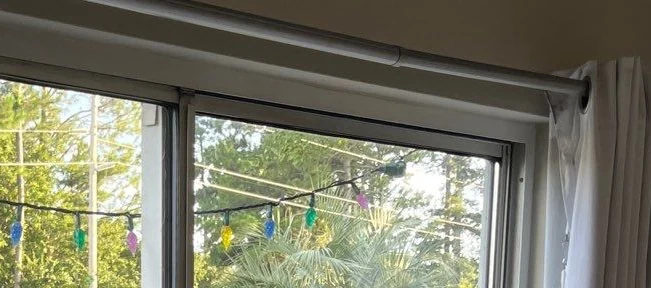
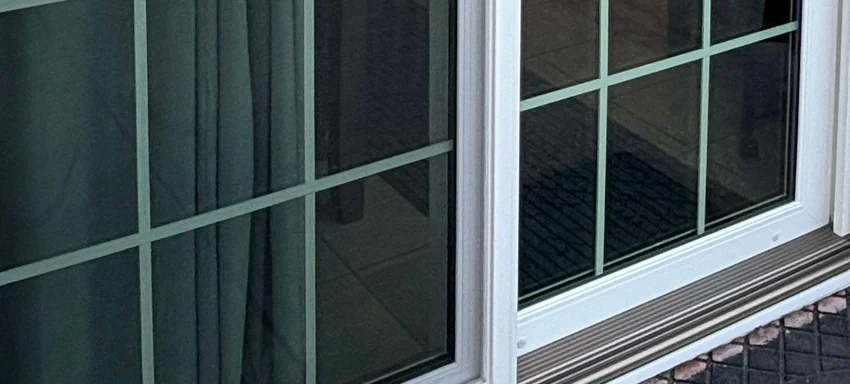
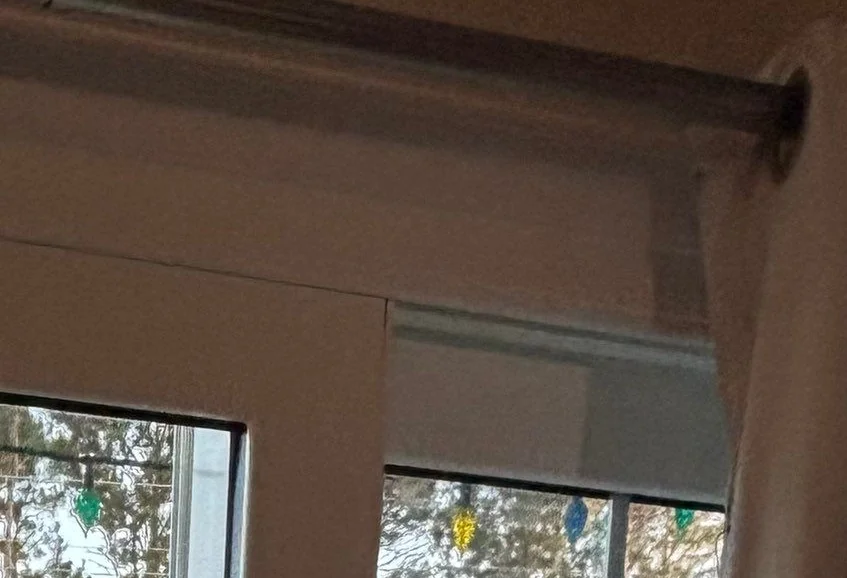
A completed Myrtle Beach project shows why it pays to look above and beside the slider. The new doorway has grids across two glass panels. From the room, a curtain hangs beside the opening and a rod spans the area above the door. The earlier image shows a room-side treatment at the original opening. Those details let you see where the privacy hardware sits relative to the glass and trim. The photos do not show a factory-blind option installed on this job.
Try the room-side approach by standing where you unlock your own door. Draw the wall space beside the moving panel, and mark where an open curtain would gather. Note anything that takes up that space, such as trim, a switch or the furniture you intend to keep. Then check whether a gathered curtain would stay clear of the handle and the place where you normally walk. An attractive fabric sample won't tell you how the fabric sits when you need to open the door with one hand.
If you also want a separate insect screen, include it on the drawing and in the quote. The patio-door screen guide helps compare how a screen opens and parks. The privacy choice deals with visibility and light through the closed glass. Write each decision down so both features are clear to the estimator.
YOUR HOME. OUR EXPERIENCE.
Compare patio-door privacy options
Bring your patio-door photo and tell us when and where you want more privacy. Contract Exteriors will call to discuss the project and confirm your estimate appointment details.
Book Your Free EstimateOur team will call to discuss your project and confirm appointment details.
Ask how each version is priced and serviced
Keep the door size, panel layout and installation scope the same wherever possible. Have the factory version show the blind option on the order and list any glass or other selection that changes with it. On the curtain version, ask what comes with the door work and who measures, supplies and mounts the rod or track. If you already own a treatment you like, ask whether any hardware or trim needs to be moved. Put that responsibility on the quote before you compare totals.
Then ask how you would clean and service each selection. A curtain stays in the room, where the fabric can be cleaned according to its care label or replaced as the room changes. For between-glass blinds, ask for the manufacturer’s operating and service information for the exact door. Ask who to contact if the control needs attention and how the quote distinguishes the door, the blind option and the installer’s work. Get those answers in writing if they affect your choice.
Bring a photo from inside the room and a second one that shows the exterior approach. Mark where the curtain would gather, if you are considering one, and where privacy matters most. If you like the factory option, leave with a line on the quote naming the exact model and blind choice. If you prefer a curtain, leave with the wall space and the treatment work marked on the drawing. If you're coordinating more than one opening, the windows-and-patio-door planning guide can help keep the choices straight across rooms.
Another Angle
Notice where the finished plane changes
A sliding door divides the room from the yard with a set of thin lines. The outside edges define the opening, the moving panel crosses another panel, and the horizontal and vertical divisions in gridded glass make the pattern more visible. A room-side curtain sits in front of all of those surfaces. When it is open, the fabric still has volume beside the opening. That small change in depth is why two doors with the same frame can read so differently from across the room.
A window treatment can deliberately change the emphasis. A fabric band beside a door can connect its color and texture to the furnishings, and closed fabric can make the wall read as one broad surface. Built-in slats keep the detail within the glass. Their repeated horizontal lines become part of the view when tilted, and they can recede when raised. It is worth looking at both states. A display with the slats already raised shows very little about how the room will feel when the owner wants more privacy.
Use the same vantage when comparing
In the Myrtle Beach images, the gridded glass organizes the view from outside. The room-side photo brings the head of the door, rod and fabric into the picture. These components belong to different visual layers. A rod at the head can emphasize the wall above the frame. A curtain gathered at one side can give that edge a stronger presence than the other. The effect is easy to miss if you judge the door as an isolated sample against a showroom wall.
Choose one everyday viewpoint from the room and one from the patio. Use those same positions for the two options. In the room, look at the frame with the fabric closed, then imagine where the fabric would gather when open. From the patio, ask whether you want to see a repeated pattern, a mostly clear panel or a softer area behind the glass. Finish samples are useful, but the view of the whole opening shows which of those details will matter most.
Keep room for a later change
Between-glass blinds make privacy a part of the ordered door. A separate treatment leaves that decision in the room. That can matter if you expect to repaint, change furniture or switch from a sheer curtain to a heavier fabric later. The ability to change a room-side treatment has value when the room is still evolving. A factory option may be more appealing when the buyer likes the slim outline and has a clear idea of how much adjustment the window treatment should provide.
Look at the door and treatment as two parts of one composition. The glass and frame define what stays every day. A treatment changes how much of that opening feels visible or how prominent it looks in the room. A clear order shows how the two parts will work together even when they are purchased separately. A clear drawing can also leave enough space for an owner to revisit the fabric decision without asking a door installer to change the opening.
A FEW MORE ANSWERS
Questions homeowners ask
Will built-in mini blinds be available on every Elegante?
OKNA lists the option for 5- and 6-foot Elegante and Forester doors. Have the estimator confirm the exact model, size, panels and glass combination before you order.
How do I know where an open curtain will sit?
Mark the side where the door opens and measure the available wall beside it. Ask the treatment supplier where the chosen fabric will gather on its proposed rod or track.
Can I have both grids and factory blinds?
Ask for the exact glass and grid combination to be confirmed for your door order. Catalog listings for individual options don’t establish that they can be combined.
Will either choice give me blackout?
Evaluate the exact treatment, including the fabric and edge coverage for a curtain and the blind’s closed appearance on the proposed glass. Ask for a demonstration if near-darkness is important.
What do I compare on the quote?
Keep the same door model, size and scope where practical. Ask which glass and blind options are included, who supplies the room-side treatment and how each option is serviced.
Do built-in blinds replace the insect screen?
The blinds control privacy and light through the glass. Ask about a compatible screen if you want to open the glass door for airflow and still screen the opening.
Sources and review
Contract Exteriors project evidence: Internal project records and original CompanyCam photographs support the project examples described in this article. Customer records and identifying details remain private. Project examples are separate from the manufacturer guidance and other published references below.
Contract Exteriors completed the documented Myrtle Beach Elegante slider replacement. Matched photos show the original opening and the completed door with a room-side curtain. Factory mini blinds are a proposal option for a future project.
- OKNA patio door brochure — Reviewed November 24, 2026. The accessories page lists the exact families and nominal widths and describes raising, lowering and tilting the optional between-glass mini blinds.
- OKNA Elegante product page — Confirm exact model terminology and discuss available configurations without carrying over claims to the installed example.
- OKNA care and support — Review the mini-blind operation and maintenance resource for the factory option. No promise about warranty or servicing the pictured unit.
Editorial review details
Reviewed for Contract Exteriors by Bill Schum, Marketing Director, Contract Exteriors, on November 24, 2026. Scope: Bill Schum provides editorial oversight. Source and project records, authorized photos and phone and desktop presentation were checked. AI tools supported research, drafting and editing.
Our sourcing and corrections standards · Report a correction
Related planning resources
doors · patio doors · planning · okna · myrtle beach