A good comparison starts with your own front door
Local examples at a glance
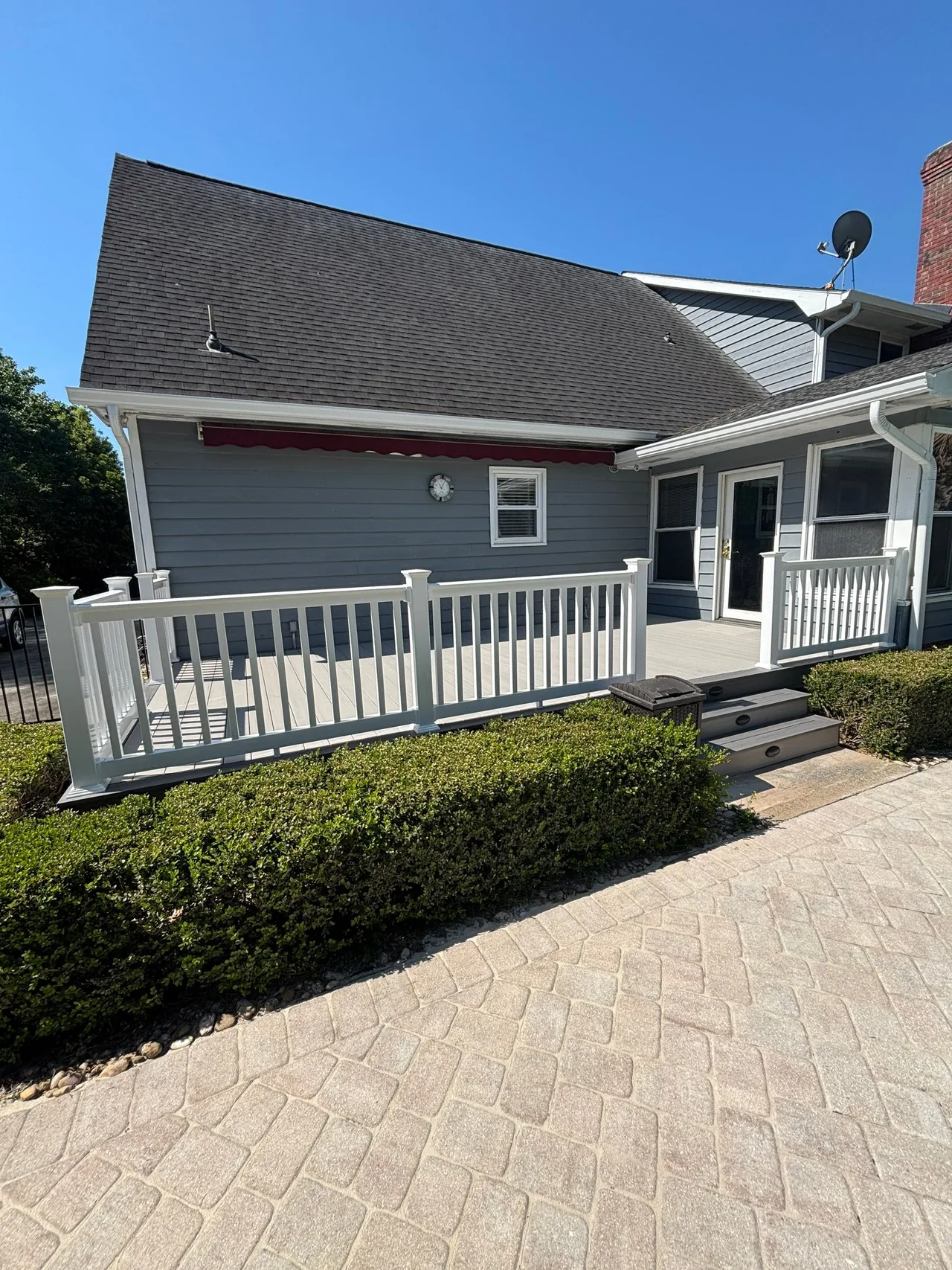
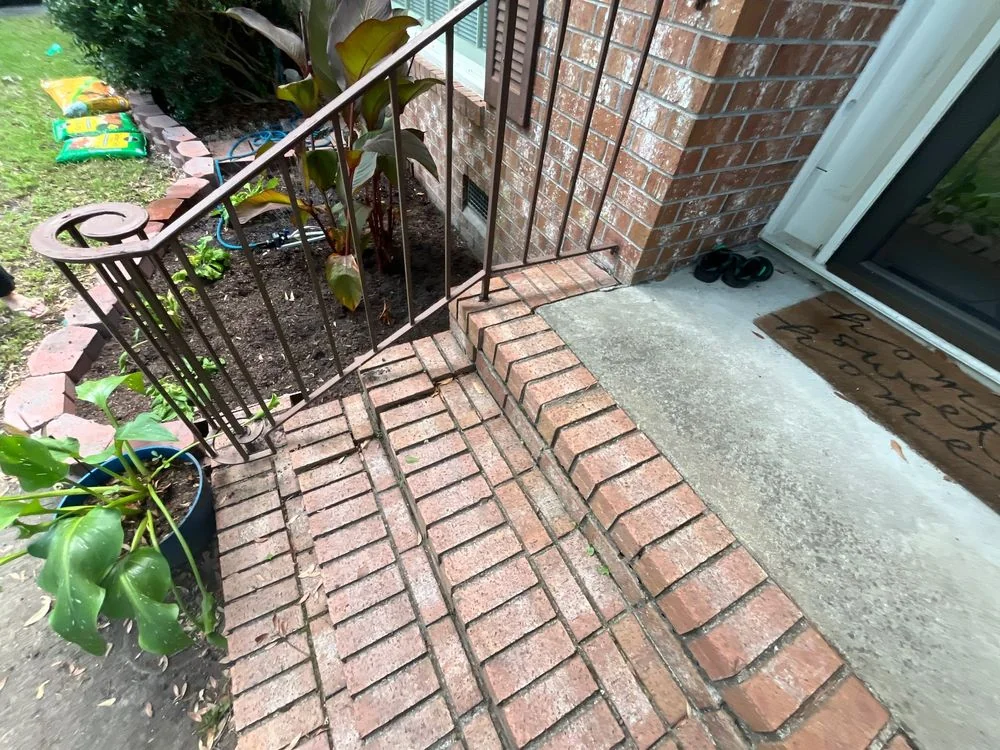
- Charleston front entrance
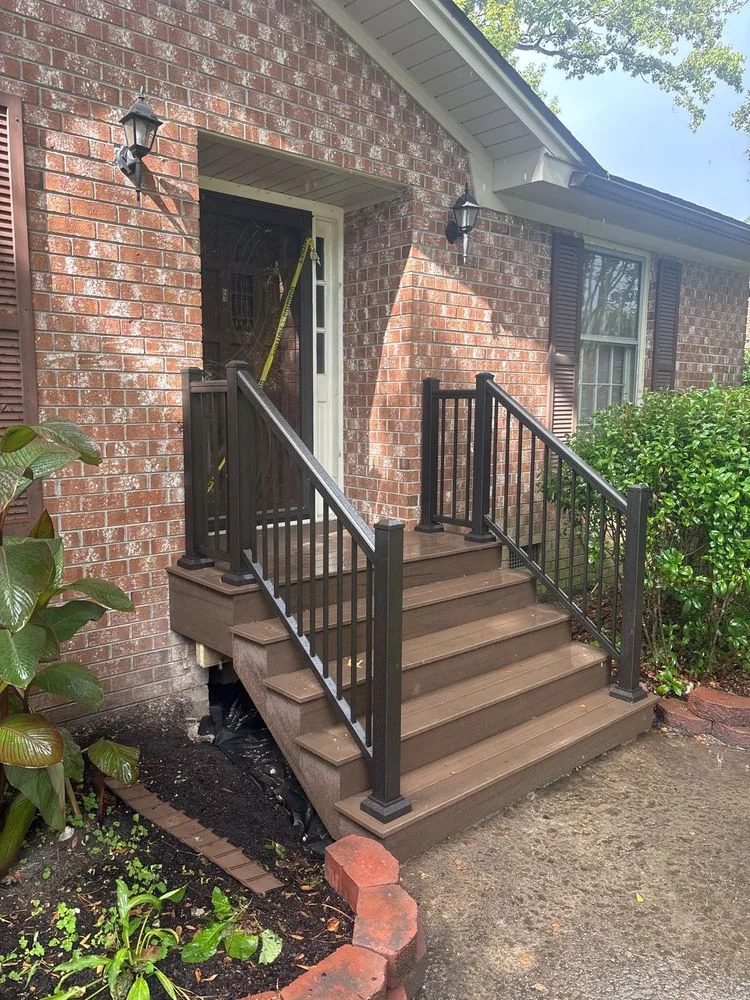
- Original brick steps and landing; TimberTech EDGE Prime+ composite listed in project records. Later installation views show brown decking and black railings.
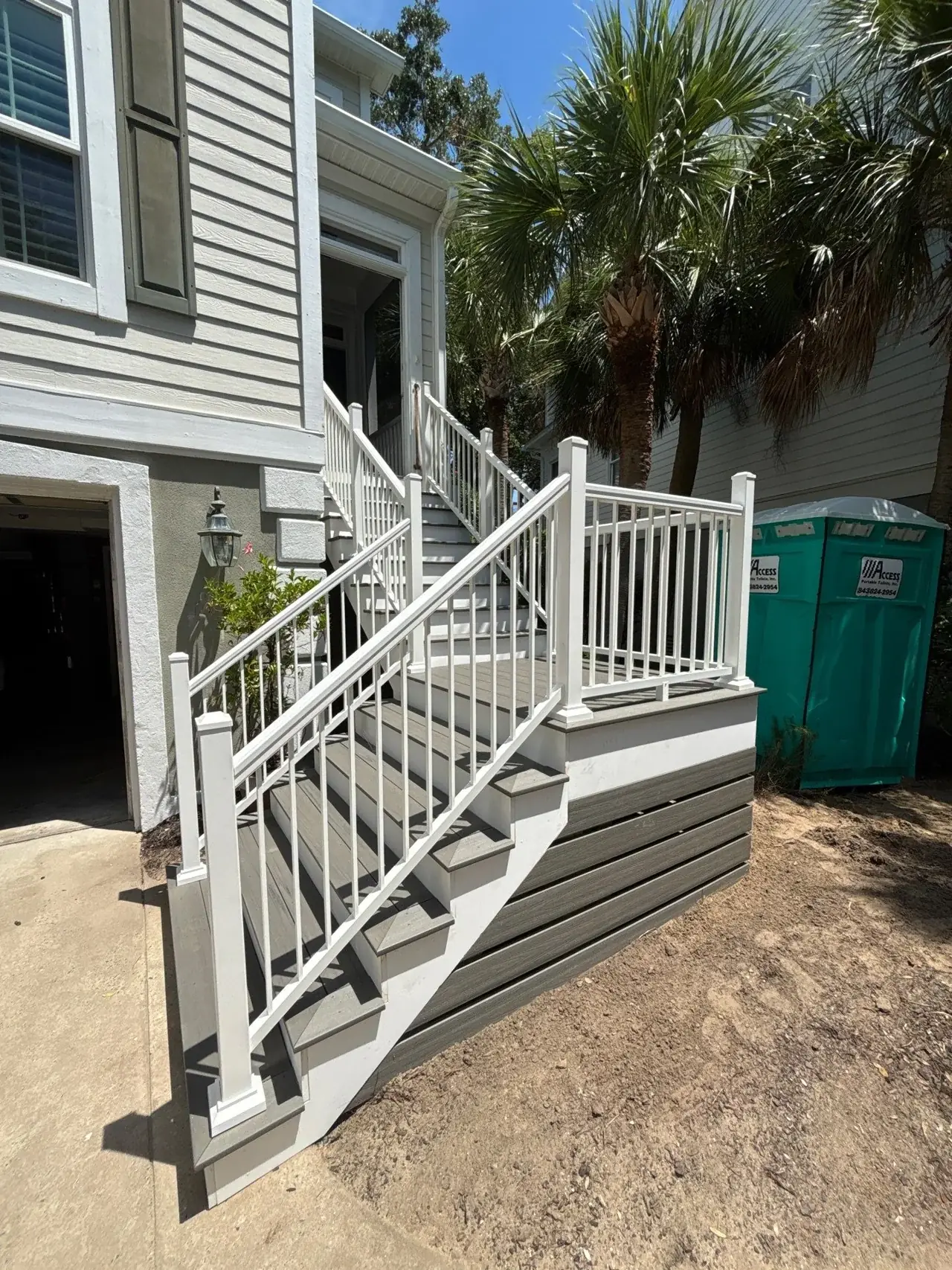
- Charleston raised deck
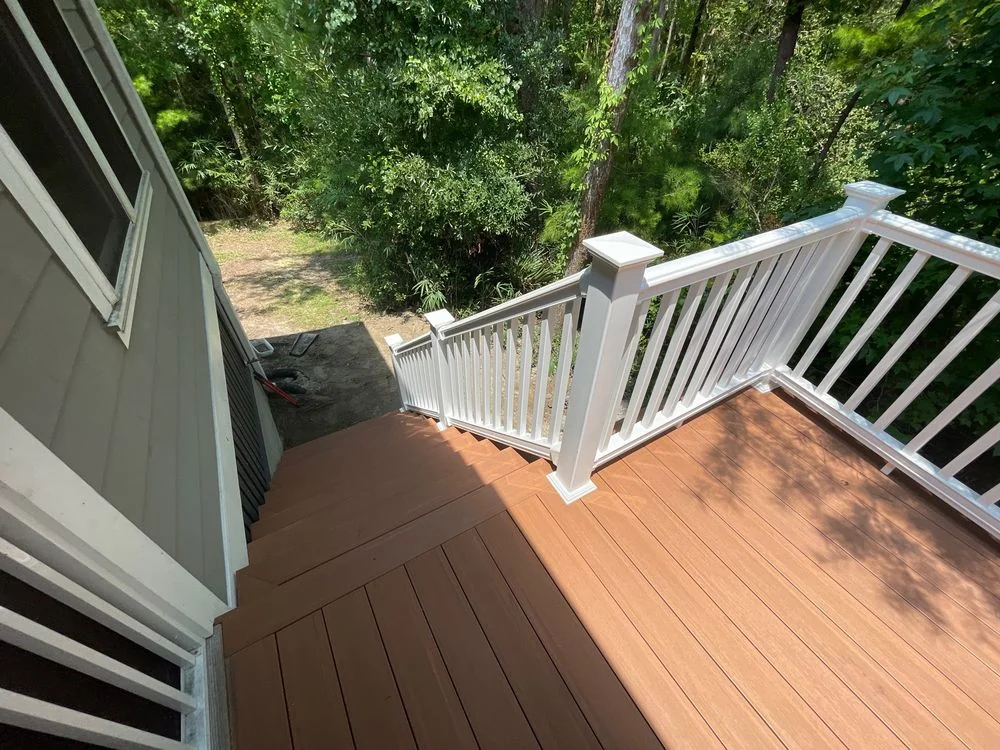
- AZEK Vintage listed in the separate project record; July photos show the landing, stairs and white railings during installation.
- Scope of these examples
- Actual Contract Exteriors layouts and product records; neither project was a controlled brand-comparison trial.
It's easy to spend an evening comparing deck boards and still feel no closer to choosing one. A long warranty sounds reassuring. A cooler surface sounds even better. Then you notice that the two quotes describe different materials—and neither explains much about the stairs.
For a home around Charleston or Myrtle Beach, start with the parts of the space you'll use. That might be a sunny sitting area, a shaded landing or the steps you cross every morning. South Carolina's State Climatology Office describes warm, moist summer air moving inland from the Atlantic. That makes weather exposure a sensible part of the conversation, but the amount of sun and shade at your house still needs its own look.
Two Charleston projects show why the conversation needs to go beyond the board. Contract Exteriors documented a front-entry replacement with TimberTech composite, and a separate raised deck-and-stair project whose product record names TimberTech AZEK Vintage. One meets a brick entrance close to the ground. The other connects an elevated outdoor area to the yard. Both involve decking; they ask different things of the finished design.
First, make sure you're comparing the right boards
TimberTech sells both capped composite and Advanced PVC decking. Composite includes wood particles and plastic. Advanced PVC uses a different construction; the Vintage technical sheet specifies polymers with no wood fibers. Armadillo's March 2026 evaluation describes its listed boards as wood-fiber-and-plastic composite with a protective cap.
That distinction matters because comparing Armadillo composite with TimberTech PVC is partly a material comparison. It doesn't tell you how Armadillo compares with every TimberTech composite collection.
The front-entry example helps keep this practical. Its recorded selection is composite. Describing those steps as an example of PVC's moisture or heat performance would be the wrong comparison, even though both product families carry the TimberTech name.
Sources: TimberTech technology · TimberTech Vintage technical sheet · Armadillo ESR-1461
Where TimberTech Advanced PVC has a clear case
We'd give Advanced PVC a close look when a homeowner wants a wood-free board and wants to explore different board proportions. Vintage's published options include narrow, standard and wide widths. That's a useful design choice, particularly when you're deciding how a larger platform and its smaller landings should relate. It doesn't mean every width belongs in every layout.
There is also a concrete moisture-test result to discuss. The Vintage technical sheet reports water absorption below 1.2% by mass under ASTM D1037, and a no-decay rating under its listed fungus test. Those are more useful facts than calling a deck “waterproof.” They describe the tested material; drainage, supporting construction and care remain separate parts of the project.
For the second Charleston example, the recorded collection is Vintage, so PVC-specific questions belong in that discussion. The installation includes a raised landing and a long stair connection. The photograph helps you think about the parts that need to work together: walking surfaces, stair edges, rails and the route into the yard. It doesn't tell us how hot the boards felt or how they will look years from now.
If you're deciding between TimberTech's two material families, our composite-versus-PVC guide follows that narrower question through a Conway project.
Sources: TimberTech Vintage technical sheet
YOUR HOME. OUR EXPERIENCE.
Thinking about updating your deck?
Talk with Contract Exteriors about your existing deck, material choices and how you want to use the space. Start with a free estimate.
Book Your Free EstimateOur team will call to discuss your project and confirm appointment details.
Take the heat claim seriously—and read the qualifier
TimberTech markets selected Advanced PVC Cool Touch colors as staying up to 30° cooler than traditional composites. Its disclaimer also says all decking gets hot in the sun and darker colors feel hotter. That makes collection and color part of the decision.
We haven't established an Armadillo-specific test that supports promising that difference at your house. Ask which boards and colors a comparison actually tested. A headline number without that information leaves too much out.
Bring the samples outside beside the house finishes. Look at them in the areas where the deck will sit, and talk through shade and the times you expect to use it. Handling samples can help with a personal choice, but a casual touch test isn't a controlled performance study.
Sources: TimberTech technology · TimberTech disclaimers
Published traction tests are useful, but they aren't interchangeable
The National Research Council of Canada's evaluation of AZEK Harvest and Vintage publishes wet and dry traction results. For example, Vintage's wet coefficients are 0.606 along the board and 0.719 across it, above the evaluation table's 0.5 criterion. These are laboratory friction measurements for the evaluated products, not a guarantee against slipping.
A separate NRC assessment publishes lower figures for Armadillo Heritage and Lifestyle, along with an occupant-expectation caution. The assessment remains active and says those supplemental results don't invalidate its compliance opinion. It doesn't cover Evolution.
We aren't turning those separate tables into a percentage advantage: the available manufacturer summaries identify different test methods, and the underlying conditions haven't been matched. What you can do is request the applicable traction information for the exact board being quoted. Then include cleaning and the everyday stair route in the discussion. Our winter footing guide covers the care side in more detail.
Sources: NRC/CCMC 13690-R · NRC/CCMC 13569-R · Armadillo performance summary · TimberTech Vintage technical sheet
Compare the residential warranty in separate pieces
A material warranty, a fade-and-stain warranty and replacement labor coverage answer different questions. Read each one before using the largest number as your tie-breaker.
Armadillo's actual terms also include a fade threshold and a stain-claim procedure, so describing it as having no fade or stain provisions would be inaccurate. Warranty length alone doesn't give TimberTech a clean win.
TimberTech's replacement labor program adds another layer. Eligibility and duration depend on the contractor's program tier, installed products, required fasteners and registration. Ask for the coverage that applies to your written proposal, including what you need to register. Don't assume a general brochure headline is your entitlement.
Sources: Armadillo Golden Promise actual warranty · TimberTech Advanced PVC fade/stain warranty · TimberTech composite fade/stain warranty · TimberTech replacement labor warranty
Make the installed proposal your final comparison
The two Charleston projects are a reminder to include the whole job. Entry steps beside masonry and a raised deck beside a screened porch won't have the same scope. A board-only price won't explain what happens at those connections.
Ask each proposal to name the board collection and color, the work being done to the supporting structure, the stair and railing scope, removal and disposal, and the proposed fasteners and trim. Ask who handles applicable approvals and what conditions could change the price. If an existing deck may be retained, our rebuild-or-resurface guide explains the separate scope decision.
Then request the care instructions. TimberTech specifies different brushes for composite and Advanced PVC, so even the maintenance conversation needs the exact product. Our guide to decking under trees helps with that part of ownership.
Our recommendation: start with TimberTech Advanced PVC when its wood-free construction and design options match what you want from the space. Compare a named TimberTech composite collection when you're considering that material instead. Keep Armadillo's actual residential warranty in the comparison, and judge any price difference against equivalent installed work. That gives you a reasoned choice you can explain after the sample boards are put away.
Our decking resources can help you organize the questions before comparing samples and complete proposals.
Sources: TimberTech Care & Cleaning
Another Angle
Judge the edge as carefully as the surface
A decking sample is a small, isolated piece of a much larger composition. It removes the very relationships that will determine how the finished project reads: the height of a landing, the depth of a stair, the color of the adjacent wall and the rhythm of the railing. Our editorial view is that a material earns its place through those relationships. A convincing wood grain is useful, but it cannot settle the appearance of a complete exterior on its own.
The two Charleston examples make that distinction visible. At the brick entrance, brown horizontal surfaces sit within an existing palette of brick, dark shutters and black railings. The new walking surface occupies a relatively small area, yet its edges are prominent from the approach. On the separate raised deck, pale risers and white railings frame the brown boards. The contrasting vertical elements give the stair a different visual weight. Neither arrangement establishes that one material performs better. They demonstrate how the surrounding components change the effect of a board selection.
Let the scale of the space guide the pattern
Consider a hypothetical homeowner drawn to a wide board because it looks calm on a large display deck. That same preference deserves a second look on a compact landing with several changes of direction. A small area may offer little opportunity to appreciate a broad repeating pattern. The eye may notice perimeter pieces, stair fronts and short joints first. The useful design exercise is to sketch the visible board arrangement at the actual entrance, rather than approving the material from an isolated sample.
The opposite tradeoff can arise on a larger platform. A pronounced pattern may give an expansive area structure, but it may also compete with closely spaced railing elements or a strongly patterned wall. An understated surface can allow those retained features to remain dominant. This is a judgment about visual hierarchy, not a rule that every coastal home should use the same color or board width. Material options create possibilities; selecting fewer competing features can be as deliberate as adding a decorative border.
Make the finish schedule part of the decision
Before treating two proposals as aesthetically equivalent, ask to see how each handles the visible transitions. Identify the proposed riser and fascia colors, the railing profile, the exposed board edges and the meeting point with the house. A finish schedule gives those choices names and locations. It also makes an alternative easier to evaluate: a different board collection may be acceptable while a different stair treatment changes the whole approach. Installation and structural suitability remain separate professional questions.
This offers a useful way to think about a premium selection. Decide which feature you will actually see and value after the novelty of the sample has passed. It might be a particular surface finish, a board proportion or a more coherent relationship with the house. If that feature survives the complete layout and proposal comparison, the preference has a clear purpose. If it disappears beneath furniture or sits in tension with the existing architecture, a different choice may make better use of the project budget. The strongest material recommendation accounts for both the documented product and the space it is being asked to complete.
A FEW MORE ANSWERS
Questions homeowners ask
Is TimberTech AZEK the same thing as TimberTech composite?
No. The AZEK-named decking in the local Vintage example is PVC. TimberTech's capped composite is a separate material family. Ask the proposal to state the collection and material so the care instructions and warranty match the boards.
Does a 50-year warranty mean the entire installed deck is covered for 50 years?
No. A warranty's term doesn't automatically cover supporting construction, railings, labor and every cause of damage. Request the applicable material, fade-and-stain, labor and installer-workmanship documents separately. Read the remedies and exclusions as well as the duration.
What does “non-prorated” mean when comparing these warranties?
It means the covered recovery doesn't shrink simply because the product gets older during the stated term. Armadillo's Golden Promise describes non-prorated material coverage for qualifying Evolution and Lifestyle purchases. That still leaves claim conditions and exclusions to read.
Can I assume every TimberTech color will feel cooler than Armadillo?
No. TimberTech's comparative heat claim applies to selected Advanced PVC colors and carries a sun-and-color qualification. The reviewed evidence doesn't establish that every TimberTech color is cooler than every Armadillo color.
Will choosing PVC let me keep my existing deck framing?
The board choice doesn't settle that. Have the existing structure and proposed work assessed together, including the stairs, connections and required fastening. Ask the contractor to explain what can stay and why before deciding between resurfacing and a rebuild.
How can I compare quotes if the brands and collections differ?
Keep the proposed footprint, stairs, railings, supporting work, removal and finish details visible in both quotes. Then identify the exact material difference and its applicable warranty. A lower total doesn't establish a lower board price when one quote includes less work.
Sources and review
Contract Exteriors project evidence: Internal project records and original CompanyCam photographs support the project examples described in this article. Customer records and identifying details remain private. Project examples are separate from the manufacturer guidance and other published references below.
The two anonymous Charleston examples draw on matched Contract Exteriors project records, original CompanyCam photographs and signed completion documentation. Product names are attributed to project records. Images retain their documented installation stage. No measured temperature, traction, long-term durability, comparative cost saving or Armadillo installation outcome is claimed. Primary product sources were checked November 3, 2026.
- South Carolina State Climatology Office — South Carolina Climate; regional context
- TimberTech technology — Retrieved November 3, 2026; manufacturer comparative claims
- TimberTech Vintage technical sheet — Manufacturer technical summary; technical-data table
- Armadillo ESR-1461 — March 2026; pp.1–5
- TimberTech disclaimers — Retrieved November 3, 2026
- NRC/CCMC 13690-R — Active; modified July 23, 2026; Tables 1–2 and limitations
- NRC/CCMC 13569-R — Active; modified June 19, 2026; Tables 1, 4, 6 and limitations
- Armadillo performance summary — Undated; legacy upload path 2017/03; p.2
- Armadillo Golden Promise actual warranty — 03/23; pp.1–4; purchases after February 1, 2023
- TimberTech Advanced PVC fade/stain warranty — 04202026; pp.1–3
- TimberTech composite fade/stain warranty — V100123; pp.1–3; verify newer collections separately
- TimberTech replacement labor warranty — V062526; pp.1–3
- TimberTech Care & Cleaning — Current product-specific brush and cleaner guidance
Editorial review details
Reviewed for Contract Exteriors by Bill Schum, Marketing Director, Contract Exteriors, on November 3, 2026. Scope: Editorial oversight and publication approval under delegated quality checks, with AI-assisted research, source and project-record checks, photo-originality review, drafting and editing. Design commentary is an editorial perspective, not professional architectural or engineering advice or a property-specific assessment. The native article was checked at phone and desktop widths.
Our sourcing and corrections standards · Report a correction
Related planning resources
decking · planning · timbertech · charleston · myrtle beach